The engineer's prose, exactly as written. No forms, no portals, nothing to install.
Outcomes Automation / What I produce
The documents that keep a right-of-way contract fed.
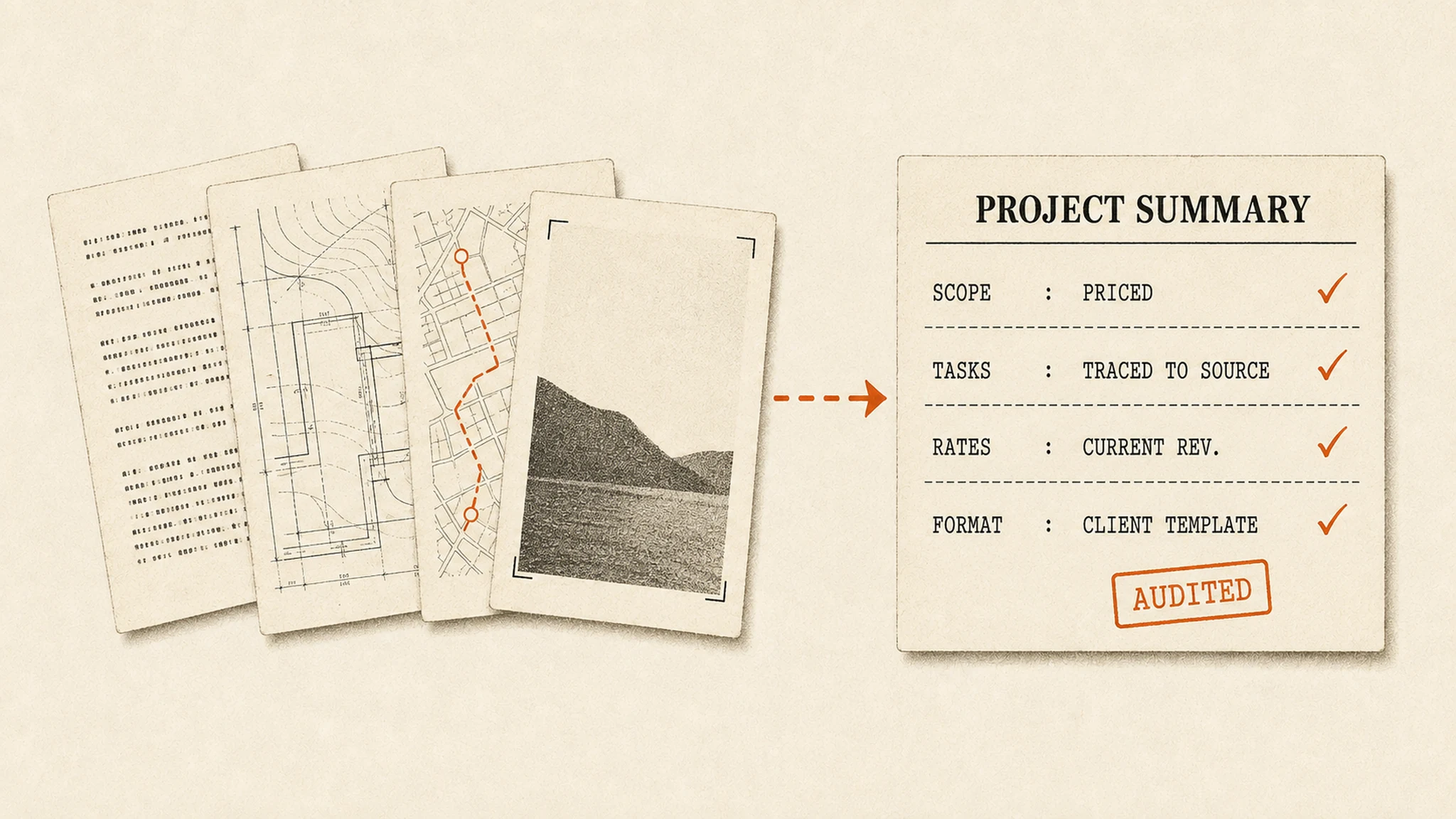
Everything below ships the same way: on your client's template, priced from the current rate sheet, audited line-by-line against the source, human-signed. The pipeline behind it trained on 26,817 right-of-way documents and best practices from across the industry. Your firm's own history gets folded in at onboarding.
The catalog
One production standard, every document type
-
Individual scopes of work
The core product. An engineer's email and parcel details go in. A priced, formatted scope on your client's own template comes back inside a day, every task traced to a sentence in the source. When a scope needs defending, it ships with a technical rationale that lays out the reasoning and the open questions. This is the document the case study follows end to end, and there's a complete sample of one you can read right now.
-
Cost estimates
Priced from your current rate sheet with a not-to-exceed structure your client's engineering group can approve without a call back. Where a count is genuinely uncertain at intake, permits, landowners, easements, the estimate states its basis and carries the contingency in writing. When the rate sheet changes, the pipeline changes with it; that has already happened in production, without a miss.
-
Change orders, from whatever the field gives you
Your agent calls it in, texts photos, or leaves a voice note about the cattle gate and the extra parcel visits. The pipeline takes that narrative, in writing, images, or audio, and turns it into a change order priced against the rate sheet and justified in the language the utility's paperwork requires.
Each one is numbered against a ledger of every prior change order on that purchase order. That anchors the amended not-to-exceed to what your client actually approved, and the math reconciles to the penny. Change orders built this way routinely clear review on the first pass. $150 flat.
-
Trained on your wins before it writes for you
Onboarding starts with your own record: past scopes, your writing, your awarded work, and your change-order history get analyzed and folded into the model that drafts for your firm, and nowhere else. Nothing you share enters the shared corpus or any other client's work. Scopes come out more accurate in the first place, which is the quiet way to cut overruns and reduce how many change orders you need at all.
-
Reads whatever your client sends
KMZ files, plan sets, parcel data, and the engineer's phone-typed email. The pipeline also pulls and visually reviews satellite imagery of the corridor, noting road proximity, adjacent parcels, and access constraints the way an estimator standing at the site would. When the written scope and the site photos disagree, that disagreement is the most valuable finding in the estimate, and it comes back to you before anything gets priced.
-
Template and rate-sheet custody
Shops running transmission, pipeline projects, title, and renewables for different clients carry a different template and rate structure for every one of them. The pipeline holds all of it, current, so the right format and the right numbers show up regardless of which client the email came from.
-
Tracking until your client approves
Submission is a state I verify, not assume. That rule comes from a real three weeks: a change order once sat marked ready to submit while everyone assumed someone else had sent it, and a duplicate nearly got written. Now every document's status is tracked from draft through your client's approval and purchase order, and anything left waiting gets surfaced and chased.
-
Bid and proposal support
The pipeline is supervised by a proposal writer with twenty years of winning submissions. When the next utility or DOT solicitation lands, the same discipline that prices a scope can shred the RFP, build the compliance matrix, and draft the narrative.
It starts with a free bid/no-bid read, delivered in writing inside 24 hours, so you know whether to spend anything at all. The response itself is quoted per solicitation, typically $2,500–$12,000 by size and complexity, because no two are alike.
The project types this desk has priced in live production:
Valve replacements · ILI runs · pipe exposures · corrosion control installs · reg station rebuilds · meter stations · AC mitigation · power drops · road & ditch crossings · security fence permitting · easements & acquisition
Send it the way your engineers already send it
KMZ files
Parcel and route geometry read directly, locations reconciled against the request.
Plan sets
Drawings and sheets attached to the project, referenced where the scope requires them.
Photos
Site conditions from the field, folded into scope language and change-order justification.
Voice memos
An agent talking through what happened is enough to build the narrative from.
Satellite imagery
Pulled and reviewed for the corridor itself: road class, access, adjacent parcels, constraints.

One pipeline underneath every document type. The intake step extracts the same structured project data, parcels, tasks, engineer, rates, and deadline, whether what comes back is a scope, an estimate, or a change order. That's why formatting never drifts and pricing never lags a rate-sheet revision.
How the engagement runs →Whichever one is due this week, send that one.
$250 per scope or estimate, $150 per change order, flat. The first document is free on a live project, so you judge it on your own paperwork.